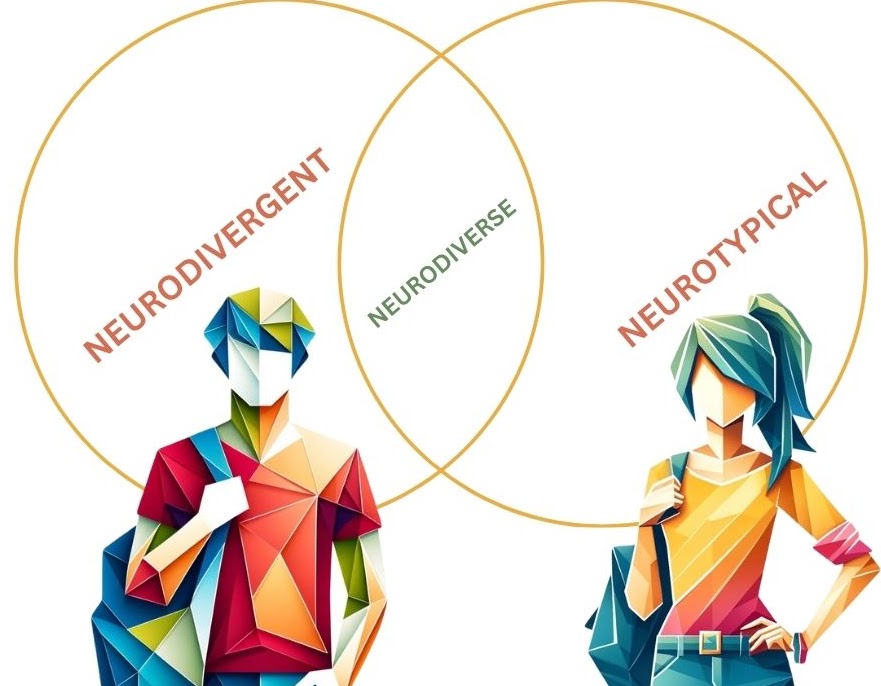
Most of us think, learn, communicate, or experience the world a little differently from someone else. Some of those differences get a diagnosis. Some don't. Neurodivergence gives us a way to talk about those differences without automatically treating the person as a problem to fix. [1] [2]
It isn't a magic word, though. Neurodivergence doesn't mean every difficulty is actually a strength, and it doesn't mean disability disappears if we're sufficiently positive about it. Someone can be neurodivergent, disabled, proud of who they are, and very much in need of support. All of those things can be true at once.
A quick vocabulary detour
These words are related, but they're not interchangeable.
Neurodiversity refers to the variety of ways human brains and nervous systems work. It's something a population has, not a diagnosis an individual receives. A college is neurodiverse because its people think and process information differently.
Neurodivergent describes a person whose neurological functioning differs from what their society generally considers typical. Autism and ADHD are familiar examples, but the word is broader than either. You'll also hear it used in discussions of dyslexia, dyspraxia, Tourette syndrome, and other conditions. There isn't a single official list, and people don't all use the label the same way.
Neurodiverse describes a group with different neurological profiles. One person isn't neurodiverse, however interesting that person may be. A classroom, a workplace, or a group of friends can be.
Neurotypical describes people whose neurological functioning falls broadly within common social expectations. It doesn't mean they think alike or never experience difficulties.
Disabled and diagnosed aren't bad words. A diagnosis may help someone understand their experience or access treatment, services, and legal protections. Disability can involve substantial day-to-day difficulty, environmental barriers, or both. Treating disability with respect does not require making it sound effortless. [3]
An everyday example: “Our class includes neurodivergent and neurotypical students” describes people. “Our class is neurodiverse” describes the group. Neither sentence tells you what any particular student needs, so you'll still have to ask.
Where did the language come from?
The neurodiversity movement grew through autistic self-advocacy, disability-rights activism, and community discussion in the 1990s. Judy Singer's scholarship and Harvey Blume's journalism helped bring the ideas to wider attention, but the movement wasn't invented by one person sitting alone with a particularly good vocabulary. Botha and colleagues have documented the importance of collective community contributions. Kassiane Asasumasu later coined neurodivergent and neurodivergence as deliberately broad terms. [4] [5]
Nick Walker's short essay on neurodiversity terminology is also worth reading. It comes from community writing, not a dictionary committee, and helps explain why words such as neurodiverse and neurodivergent are not interchangeable. [6]
That history matters because neurodivergent people weren't simply the subjects of the conversation. They helped start it. They should also have a meaningful role in deciding what good support looks like and whether a proposed solution actually helps.
Different doesn't mean defective. It doesn't mean easy, either.
Imagine a student who misses steps when an instructor delivers a long set of directions aloud. One instructor may decide the student isn't paying attention. Another writes the steps down, and the student completes the assignment without difficulty.
The student hasn't changed. The instructions have.
Now imagine a student who experiences intense sensory overload from bright lights or noise. Changing the environment may help considerably, but it may not eliminate the underlying difficulty. Both the student's needs and the environment matter. There isn't much value in arguing that everything is either the person's fault or society's fault when we could be working on the problem. [7] [8]
This is one reason the medical and social understandings of disability are both worth knowing. Diagnoses can describe real impairments and guide appropriate support. The social model asks which obstacles come from the world we've built around people. Neither question cancels the other.
Access is not the same as belonging
A student may have an approved testing accommodation and still be treated as a nuisance for using it. They may be invited to a group project but have their contributions ignored because they communicate differently. They may be physically present in class while spending half their energy figuring out how to appear engaged.
Those are different problems.
Access means being able to obtain and use an opportunity, service, or adjustment. Participation means having a meaningful way to take part. Belonging is harder to measure, but it's about being recognized as a legitimate member of the community, not a temporary exception everyone has agreed to tolerate.
No instructor can order a student to feel like they belong. But an instructor can explain expectations, take different forms of participation seriously, handle accommodations without public drama, and correct a misunderstanding without humiliating anyone. A college can do much the same at a larger scale. [9] [10]
The unwritten rules of college
Students come to college to learn. Quite a few also end up doing an invisible second job: translating the institution.
What does “be professional” mean in this class? Can I email an instructor on the weekend? Are office hours only for students who are failing? What exactly counts as participation? Does “see me after class” mean I'm in trouble?
These questions aren't silly. Colleges routinely expect students to know procedures and social rules that nobody has actually explained. Karp and Bork documented this problem in community colleges generally, not only among neurodivergent students. [11]
Instead of: “Be proactive if you're struggling.”
Try: “If you're stuck for more than twenty minutes, email me the assignment name, the step you're on, and your question. I'll reply within two working days. You can also come to office hours on Tuesday.”
That doesn't make the assignment easier. It makes the instructions usable.
Communication goes both ways
Autistic people are often described as having difficulty understanding other people. Sometimes that's true. But other people can have just as much difficulty interpreting autistic communication.
Damian Milton's double empathy problem asks us to consider what happens when people with different communication styles misunderstand one another. It's a way of thinking about reciprocal misunderstanding, not a claim that every conflict is evenly shared or that harmful behavior should be ignored. [12]
A direct question might be interpreted as rude. A polite hint might be so indirect that the intended message never arrives. Instead of deciding who is socially defective, try making the expectation explicit and checking what both people understood. It sounds almost too simple. It also saves a surprising amount of frustration.
Expectations, accommodations, and the right to try
A neurodiversity-informed approach doesn't mean removing meaningful standards. If a student is learning public speaking, speaking is part of the work. If a student is demonstrating knowledge of history, insisting on one particular presentation format may or may not be essential to that objective. Those are questions about what the course actually teaches, along with individual access needs and legal obligations. [13]
It also doesn't mean doing everything for students. Help can be useful without becoming a takeover. A calendar, interpreter, accommodation, mentor, or family member helping someone rehearse a conversation can all support independence. The important question is who is making the decisions.
Students need opportunities to try things, make choices, get stuck, repair mistakes, and deal with consequences. Those opportunities should come with fair access and appropriate support, not be replaced by either endless supervision or abandonment in the name of independence.
What about the research?
There's good evidence that college barriers and student experiences deserve serious attention. There's considerably less certainty about which specific support program works best in every setting. For example, two reviews published in 2026 examined 37 studies of wellbeing interventions and 59 articles about student engagement. They found promising ideas, but also small samples, varied methods, and big gaps in what we know about long-term outcomes. Autism and ADHD also received far more research attention than many other forms of neurodivergence. [14] [15]
So yes, clearer instructions are sensible. Structured mentoring may help. Including students in decisions is important. But we shouldn't promise that one particular technique will raise graduation rates without testing whether it actually does.
The research section explains these studies, the unanswered questions, and how to tell the difference between a useful theory and a proven outcome.
A practical way to think about it
If someone struggles, there are several questions worth asking. What exactly is difficult? What skill might help? What support would make a difference? Is the environment creating a barrier that doesn't need to be there? And, most importantly, what does the person actually want?
Sometimes the student needs a new strategy. Sometimes the institution needs to write a better email. Frequently, both things are true.
Sources and further reading
Want to go further? These are the sources behind the information above, with a short note about what each one covers.
Explains why difference and disability can both be real, and why being admitted is not the same as belonging. This is an essay, not a test of a particular support program.
Read the source ↗Explains what people mean by different approaches to neurodiversity. It does not test a classroom technique.
Read the source ↗Challenges single-founder accounts using community history and archival evidence.
Read the source ↗A useful starting point for exploring the field, not a study of student outcomes.
Read the source ↗Explains influential vocabulary used in neurodiversity communities. Useful for identity and terminology, but it does not test whether an education program works.
Read the source ↗A framework for understanding disability through person-environment fit.
Read the source ↗Helps plan accessible learning experiences. Following a checklist is not proof that students are doing better.
Read the source ↗Shows how community colleges leave important expectations unstated. The interviews were not specifically about neurodivergent students.
Read the source ↗Suggests that misunderstanding can go both ways. This is a way to understand communication, not proof about every conversation.
Read the source ↗General guidance on academic adjustments, essential requirements and differences from high school; institutions and individual situations vary.
Read the source ↗Reviews 37 studies, mostly involving autism or ADHD. Only two reported involving students in program design. The findings are mixed, not a verdict that every support program fails.
Read the source ↗Surveys 59 articles on coaching, mentoring, and other approaches. They studied different things, so there is no single winner.
Read the source ↗Looking at the same problem from a different perspective?
Understanding neurodivergenceResearch and evidence